Design Trust is pleased to share the highlights from the Keynote Dialogue between Lord Norman Foster and Lead Curator Marisa Yiu, that took place on April 9th at the Hong Kong Architectural Legacy Symposium supported by HSBC as Symposium Partner, where Lord Norman Foster shares on his experience of working on the competition for HSBC Main Building 1979, and reflection on the city of Hong Kong and the role it has played in his works and global practice. Full documentation of the Keynote Dialogue and the following panels of Hong Kong Architectural Legacy Symposium are now available for viewing on YouTube and Vimeo.

Hong Kong Architectural Legacy Symposium | Keynote Dialogue between Lord Norman Foster and Lead Curator Marisa Yiu
9. 7. 2026
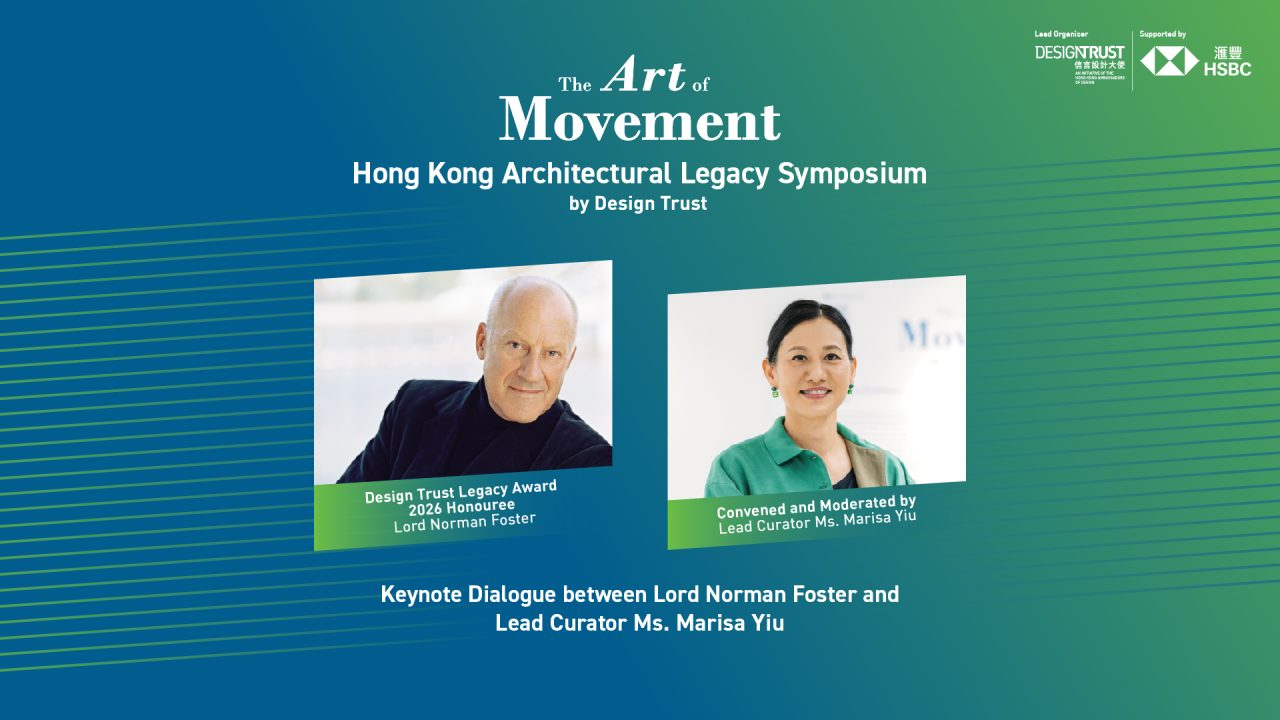
Lead Curator Ms. Marisa Yiu (MY): I was just telling Lord Foster how excited we are for this beautiful moment, as a young 10-year-old standing and taking the Star Ferry across the harbour watching this building rise. It's extremely honourable to have you with us, Lord Foster today.
To the honourable Lord Norman Foster, welcome back to Hong Kong and in Central on this special occasion of the 40th anniversary of the HSBC fourth generation building since HSBC was founded in 1865. And immense gratitude to all you have achieved, which continue to champion, and create for us here in Hong Kong with such imagination and innovation. It is an immense honour for all of us here in Hong Kong to have this opportunity to be seated with you. Design Trust is a dynamic, young, energetic, registered charity founded in 2007 as Hong Kong Ambassadors of Design. More active in the last 12 years, with the sincere mission to nurture and provide support to early career designers, grantees, architects, scholars and fellows to study the built environment and graphic design. We have also been building festivals in Hong Kong, free to the public and the community, like Inter-Island Festival and Open House Hong Kong, to make archives relevant. Mrs. Penelope Seidler is also seated here with us flying from Sydney. It has been really an exciting way to look at all your legacy and work to inspire our non-profit’s purpose.
Building all these little micro-parks in Hong Kong with Design Trust Future Studios, matching mentors and mentees, are also inspired by your ethos. You are a leading innovator and so much part of our inspiration. Lately “the Art of Movement” as a theme of our ongoing exhibition has been unpacking this question of how Lord Foster has generated this artistic movement of culture, bringing people, the networks and the community together. The show is at St. John's Building up to April 12th, at the foot of the Peak Tram Terminus. We have been examining 1970s - 1980s Central architecture and looking at how important philanthropists, patrons, architects like yourself, and commissioners articulated that 1979 competition document, to elevate the purpose of this bank building, the commitment to Hong Kong's future, and also the sheer commitment and the confidence to celebrate Hong Kong, not only as a city of an engine of generosity like yourself, but an architectural innovation.
This beautiful event would not be possible without HSBC: Mr. Cheuk Shum, thank you so much for all your support; Ms. Anna Chua, Head of Brand, and also all her colleagues; and especially Mr. David Liao, the Co-Chief executive of Asia Middle East, for their support; My Board Members present, Jonathan Cheung, Kamsen Lau, Ivan Pun, Denise Lau, and Trustees present with us.
I would love this moment to also present you our Design Trust Legacy Award 2026, and invite you Lord Foster to give us a few comments. On behalf of our non-profit foundation Design Trust, to Lord Norman Foster, for your incredible contributions to the world of architecture and Hong Kong. I always think Hong Kong is a Norman Foster's city. This trophy is by an artisanal glassblower from Hong Kong, shaped as a bamboo, representing longevity and resilience, and also your love for the blue and green economy. May I kindly invite you to say a few words?
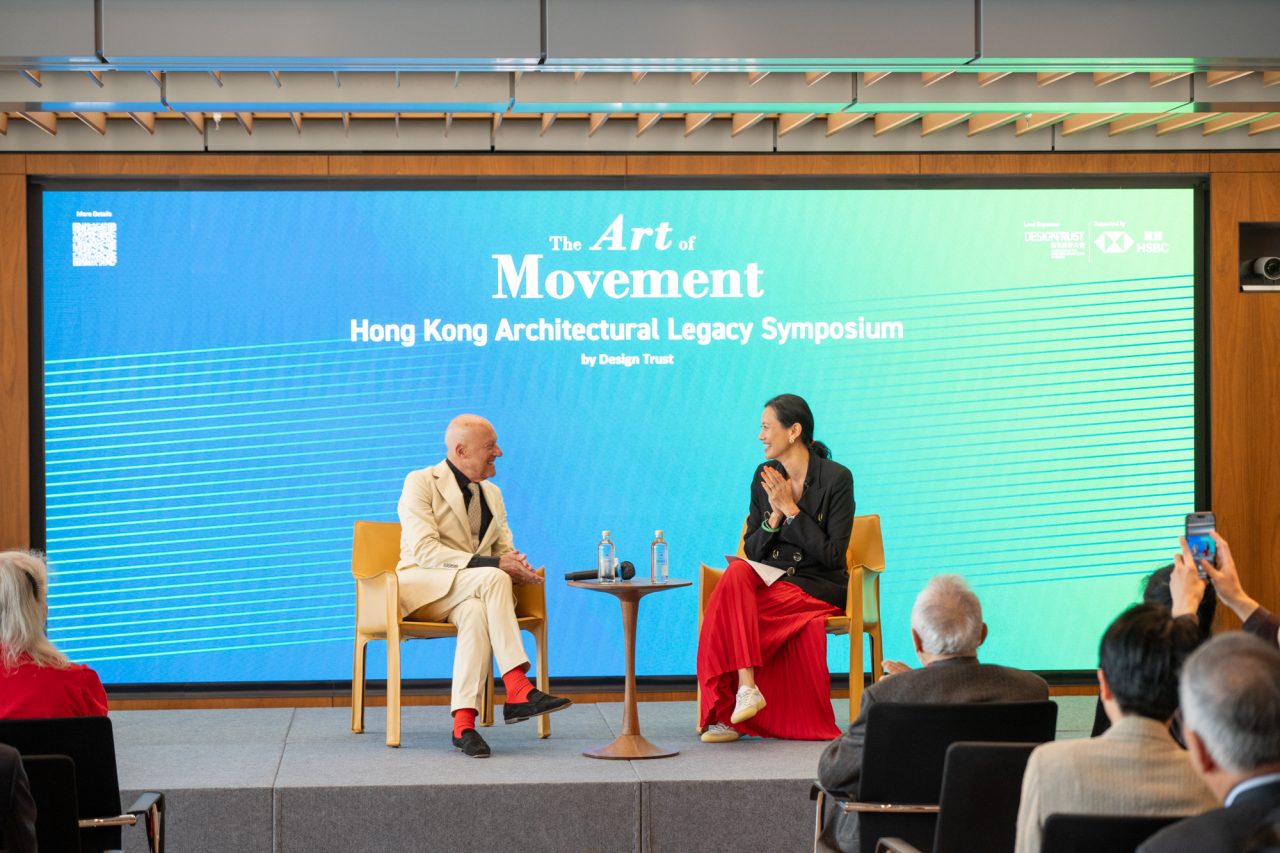
Lord Norman Foster (NF): I'm delighted and honored to receive this award. Every time I arrive in Hong Kong, my pulse quickens. There's an extraordinary anticipation. It has a unique DNA as a city, and it is palpable. I get that same rush of excitement that I did way back in 1979. I remember at that time writing the report for the competition, and anticipating the prospect of what then, would be the tallest building in Hong Kong. I remember doing a diagram and saying, “it's not about being the tallest”. It's quite interesting to come back decades later and find the building with its presence. It's remarkable the way that it commands the frontage out to the waterfront. So, coming back and finding the building alive and well, and so beautifully maintained and to see those original details, that I remember sketching.
I was just going through a team list from the practice. There were about 100 names. At that time, there wasn't here in Hong Kong, the same manufacturing capability, which we now wonderfully take for granted. At that time, everything was packaged, prefabricated, shipped in, which explains the remarkably fast construction time for this building, which even by today's standards is remarkably fast. These elements were shipped in from all around the world. Those of us who were active on the project, were moving around the world, looking, engaging with those subcontractors. And then I remember all the bamboo scaffolding, and the tales of the way in which the bamboo scaffolding would work with nature and was superior to the modern equivalent. It was a wonderful mélange. As I say, to come back here and to find that original urban fabric, that architecture is so alive and wonderfully looked after is really quite moving for me, very moving indeed.
MY: I would like to pull up this beautiful slide of Lord Norman Foster's team. At that time, there was a small liaison office established as early as January 1980. Spencer de Grey, Graham Phillips, and more. I also have this beautiful old photograph of yourself with your team. This is something I am just so impressed and inspired by is your leadership, the way you can build from a very small group of 100 members to now 2,000 members globally. How do you lead a global team since that 1979 moment? How do you inspire your team?
NF: In the end, it's about inspiring a team with shared values, and the belief in the quality of design and everything in design affects the very quality of our lives, whether it's within a building or a city. It was quite interesting that the idea of elevating the building and creating this route underneath to embrace the public was very much a social generator. But interestingly, it is impressive the authorities at that time that they extended the right to build and plot ratio to the site from 1:14 to 1:18, which was unheard of at that time. I remember the Bank saying, if the pursuit of excellence means that we have to compromise, on the commercial dimension of the building, then we'll accept that. And I think everybody was pleasantly surprised that it was the reverse, that actually, the social dimension merited an increase in the value of the site. But I am also reminded with Penelope here, of Harry Seidler's and his contribution to Statue Square with the (Hong Kong) Club building. There was at that time an extraordinary atmosphere, a cultural atmosphere, commercial atmosphere, which blended totally. That spirit of idealism, I think is still wonderfully alive and well here.
MY: You are so rooted in Hong Kong and the culture itself. There is a lot of discussions about your competition submission, working with the Feng Shui masters, the geomancers, the local community, taking endless photographs of Hong Kong's social life, the little terraces on buildings, the informal qualities to inform the design of HSBC. Could you share more on this?
NF: I remember coming here and being curious about the local indigenous architecture, the use of shade, and that was a direct influence on the building with shading. I remember at the briefing, the executive who was responsible for the project, Roy Munden, and I remember him saying, “you might hear about something called Feng Shui, but don't worry, forget it, we'll take care of it”. I remember that, of course, was a kind of siren call for me to find somebody, a Feng Shui expert, and we commissioned a feng shui expert. I remember that he did a sketch, and I forgot about that sketch; and when the building was under construction, I was invited to the Centre Pompidou to give a talk on the project. I got out this sketch and the recollection of that meeting with this expert. To my utter surprise, the design of the escalators, all followed that early sketch.
I remember getting to Hong Kong at that time was quite a big deal. When you came here, like all of the shortlisted competitors, we had planned to explore the region. Then at the last moment, I realised that I didn't really understand how the bank and the banking hall worked. I approached Roy Munden and I said, “what if instead of us going off like everybody else, we stay here and explore, and find out more about how the banking hall works?” I remember Roy Munden saying, “well, that sounds like a good idea, but of course, we'd have to tell everybody else, the other competitors”. I said, “forget it, we won't tell anybody else.”
I remember staying here, and starting to understand how that interface between the community and the bank worked. I am absolutely delighted today to find that the banking hall as a process is still alive and well, because so many banks around the world, don't have active banking halls. It's been overtaken by the technology, but there is that community element, that relationship between, the citizens here, and the bank.
MY: There are many people I think also you are inspired by. As we look at you as a role model and many present with us, your former professor teacher, Paul Rudolph at Yale University; you collaborated with Buckminster Fuller. Could you talk a little bit about that?
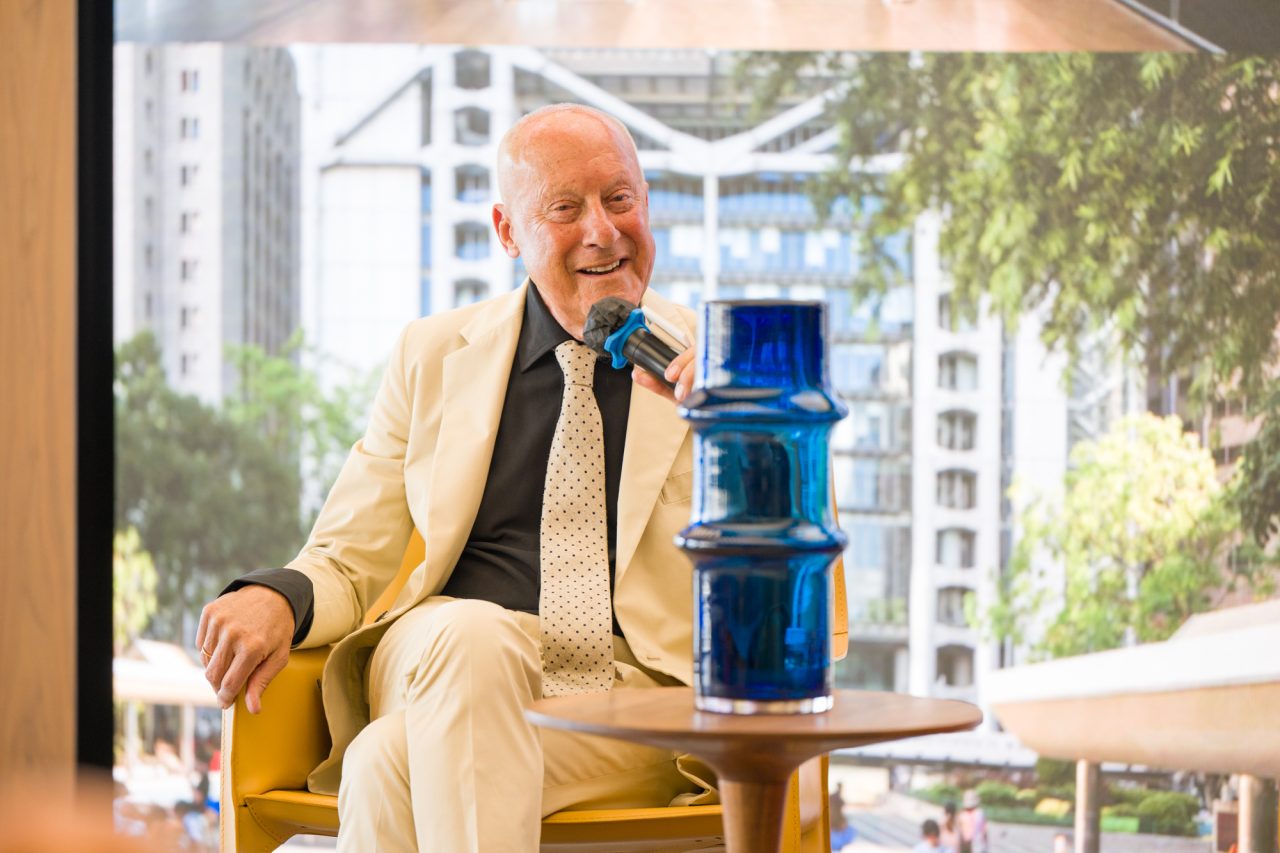
NF: Our current Hong Kong office here is in a Paul Rudolph’s building. And it is interesting when I did the master's course in 1961-62 at Yale, I remember being given a brief for a tall building. I remember saying, “I've spent five years at Manchester. I know my construction reasonably well. But a tall building, I wouldn't know where to start”.
I asked Paul Rudolph, if I could work with an engineer, which was a heresy for Paul Rudolph, who believed passionately, that the architect was the master, that the architect then farmed out to engineers to make the building work. And I said, “No, I want to work with an engineer alongside”. To his credit, he allowed that. Much later, I went back along with colleagues for a reunion. Robert Stern then was the Dean of Yale University, said that project, that Norman did as a student was the basis for the Hongkong Bank.
Because what I had done as that student project, was to challenge the central core in a tower and to move it to one side. And that is exactly what this building is. It's the manifestation of that. I think it is one of the reasons why it's been able to accommodate a dealer's floor, because there's no interruption, with unbroken views and loft-like spaces. So again, to come back and find that concept alive and well over the decades, is very satisfying.
MY: I know you have worked very hard since 2015 and 2017 to build your Norman Foster Foundation as a resource for the public. Could you just share on this amazing archive and institute that you have built and why?
NF: Well, it's a foundation, an archive, a resource center, and an educational centre. It has grown also into an offshoot, which is the Institute for Sustainable Cities. It's currently running one-year master courses and uniquely combining the two worlds of academia. The foundation has built up a network of probably 150 world experts on every issue of urbanity. The master's course combines three pilot cities working within a community but also having access dividing time in the world of academia. Typically 25 students from all over the world will share that experience. The idea is to prepare the civic leaders of the future because cities are the future, and the key to climate change. Using the most up-to-date digital tools, being able to model the possible interventions in a city: what happens if you change the ratio of the greenery, of the pedestrian, of the vehicle. Already we have graduates, who are mayors and are leading major conservation initiatives in their countries, one in Chile, for example. That is one spinoff from practice in terms of investing in younger generations in the future. I think it has a lot of overlaps between what I'm hearing about what you and your foundation Design Trust is doing, so congratulations.
MY: Thank you, Lord Norman Foster, for joining us today.
Full documentation of the Keynote Dialogue is now available for viewing on YouTube.
*The dialogue has been edited to fit the text format of Design Trust Newsletter. Thanks to HSBC and Foster + Partners for supporting the Hong Kong Architectural Legacy Symposium by Design Trust.